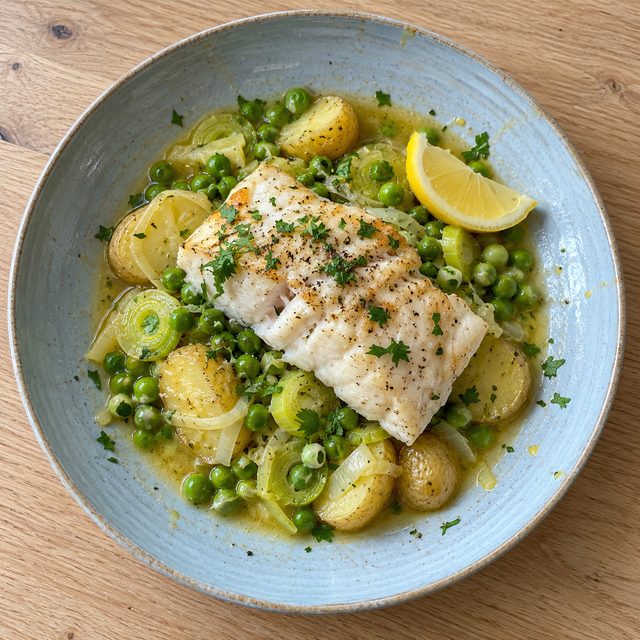
White Fish with Leeks, Peas and Potatoes
- 40 mintotal time
- $4.07£2.20a serving
- 379338calories
- 3433 gprotein
Serves 4; price is an estimate. Dinner Plan is a paid weekly plan for your household and budget. You see your week before you pay.
White fish steamed on sliced new potatoes, soft leeks and peas in a light mustard and lemon stock.
Ingredients
Serves 4.
- 1.25 lb baby potatoes, thinly sliced
- 2 leeks, trimmed, washed and sliced
- 2 garlic cloves, sliced
- 1½ cups frozen peas
- 1.25 lb frozen white fish fillets (cod, pollock or tilapia), 4 fillets, thawed overnight in the fridge
- 1 lemon
- ½ bunch parsley, chopped
- 2 tbsp olive oil
- salt, to taste
- 1 vegetable bouillon cube
- 2 tsp Dijon mustard
- black pepper, to taste
Contains: fish, mustard, celery, sulfites. Check the label: wheat (gluten), milk, egg, soy. Always read the labels if you cook for someone with an allergy.
Method
- Heat the olive oil in a large, deep frying pan with a lid on medium heat. Add the baby potatoes with a pinch of salt and cook for 4 minutes, turning. Add the leek and cook for 3 minutes until starting to soften.
- Add the garlic for 30 seconds. Crumble the bouillon cube into 1½ cups (360 ml) of boiling water, stir in the Dijon mustard and pour it into the pan. Cover and simmer for 8–10 minutes until the potatoes are just tender.
- Stir in the peas. Season the fish with salt and black pepper and lay the fillets on top. Wash your hands after handling the raw fish. Cover and cook on low heat for 6–8 minutes, until the fish is opaque and flakes easily (145°F).
- Squeeze over the juice of half the lemon, scatter with the parsley and serve in shallow bowls with the cooking liquid spooned over and the rest of the lemon in wedges.
Leftovers: Best eaten straight away; leftovers keep in the fridge for 1 day and should be reheated gently until piping hot.
Ingredients
Serves 4.
- 600 g baby new potatoes, thinly sliced
- 2 leeks, trimmed, washed and sliced
- 2 garlic cloves, sliced
- 200 g frozen peas
- 600 g frozen white fish fillets (cod, pollock or basa), 4 fillets, thawed overnight in the fridge
- 1 lemon
- ½ bunch parsley, chopped
- 2 tbsp olive oil
- salt, to taste
- 1 vegetable stock cube
- 2 tsp Dijon mustard
- black pepper, to taste
Contains: fish, mustard, celery, sulphites. Check the label: gluten, milk, egg, soya. Always read the labels if you cook for someone with an allergy.
Method
- Heat the olive oil in a large, deep frying pan with a lid on medium heat. Add the baby new potatoes with a pinch of salt and cook for 4 minutes, turning. Add the leek and cook for 3 minutes until starting to soften.
- Add the garlic for 30 seconds. Crumble the stock cube into 360 ml of boiling water, stir in the Dijon mustard and pour it into the pan. Cover and simmer for 8–10 minutes until the potatoes are just tender.
- Stir in the peas. Season the fish with salt and black pepper and lay the fillets on top. Wash your hands after handling the raw fish. Cover and cook on low heat for 6–8 minutes, until the fish is opaque and flakes easily (63°C).
- Squeeze over the juice of half the lemon, scatter with the parsley and serve in shallow bowls with the cooking liquid spooned over and the rest of the lemon in wedges.
Leftovers: Best eaten straight away; leftovers keep in the fridge for 1 day and should be reheated gently until piping hot.
Nutrition per serving
| Calories | 379 |
|---|---|
| Protein | 34 g |
| Carbohydrate | 42 g |
| Fat | 9 g |
| Fiber | 7 g |
| Sodium | 806 mg |
| Calories | 338 |
|---|---|
| Protein | 33 g |
| Carbohydrate | 34 g |
| Fat | 9 g |
| Fibre | 8 g |
| Sodium | 640 mg |
Worked out from the ingredients, 446 g a serving; optional extras and salt to taste aren't counted. US and UK values differ a little because each uses that country's food data and products. US values from USDA FoodData Central.UK values from McCance and Widdowson's Composition of Foods Integrated Dataset 2021, under the Open Government Licence v3.0.
What it costs
About $4.07 a serving in the US (range $3.11–$5.40) and £2.20 in the UK (range £1.68–£2.91). That's the share of each ingredient this recipe uses; basics like oil, salt and spices aren't counted.
Prices are estimates. Item prices come from public price data where available (US: Bureau of Labor Statistics and USDA; UK: Office for National Statistics). Where that data has no match, we use our own estimate. Ranges set using Open Prices data (Open Food Facts, ODbL). Prices as of October 2026. How we estimate
In our weekly plans
Build a week around this recipe
Tell us who's eating and your budget. This recipe goes into your week with dinners picked to fit your budget, one list by aisle and its estimated total, and you see the week before you pay.
Build my week